How Long Does SEO Really Take? (And why watching it daily will make you crazy)
Table of Contents Show
If you’ve ever refreshed your keyword rankings just to see what’s happening, you already know: SEO can feel downright chaotic these days. One morning you’re ranking in the top three. By the next evening, the keyword disappears off the map like it never existed.
If this rollercoaster has ever caused you heart palpitations, you’re not alone—I’ve been on that same ride. And lately, with Google releasing update after update (often inconsistently and without much clarity), the volatility has gotten even worse.
Today, let’s ground ourselves in what’s normal, what’s noise, and what long-term SEO health actually looks like.
Why SEO Feels Extra Volatile Right Now
Over the past year, Google has pushed out a string of impactful, if not erratic, algorithm updates, including:
The “&num=100” (or core ranking) 100 results update
Ongoing spam updates that come in waves
Helpful Content Update (HCU) iterations, shifting how Google evaluates content quality
Indexing adjustments and crawling delays
Each of these affects websites differently. And because Google rarely rolls updates out all at once, small ranking jumps and dips happen throughout the rollout... sometimes for weeks.
This means your rankings are going to wobble. A lot.
And obsessively checking them? That’ll make anyone lose their sanity.
How Long Does SEO Actually Take?
Here’s the part most people don’t want to hear:
Real SEO progress usually takes 3–6 months, minimum.
For brand-new sites or major website overhauls, it can take 6–12 months to see consistent traction.
This isn’t just a “be patient” message; it’s how search engines work. Google needs time to:
Crawl and index changes
Understand your site’s topical authority
Compare your pages with competitors
Test your content with different searchers
Re-stabilize after algorithm updates
Learn user behavior signals over time
Daily fluctuations are normal. Weekly fluctuations are normal. What matters is the trend over months, not days. And yes, with the rise of AI this is starting to happen quicker in some cases, but the core foundation of SEO (E-E-A-T) remains the same.
Why Checking SEO Every Day Is a Trap
If you check your rankings daily, here’s what you’ll see:
One keyword suddenly ranking at #2
Another disappearing completely
Pages bouncing around like a ping-pong ball
Tools giving you contradictory data
Your instinct might be to panic:
“Do I need to rewrite everything?”
“Should I delete that blog post?”
“Is my site broken?”
But reacting to short-term data almost always leads to bad decisions, such as:
Removing content that just needed time
Dramatically rewriting pages that were already on the right path
Over-optimizing and creating keyword stuffing
Changing your strategy too frequently to build momentum
Good SEO is slow, steady, and cumulative. Quick decisions often interrupt that compounding effect.
Sometimes a keyword disappearing from your ranking is simply that the specific page the keyword was ranking on changed. This can be a very good thing if you’re optimizing your site! If you’ve implemented good SEO, the keyword ranking will shift to the appropriate page and perform better than before. You’re still ranking, but Google is in the process of adjusting which page to serve users searching for the term.
Free Tools vs. Pro Tools: Why Your Data Doesn’t Always Match
Most small businesses use free tools like Google Search Console (GSC) or something low-cost like Ubersuggest. Don’t get me wrong, these tools are great for getting started. I use Google Search Console in tandem with my other tools daily, especially for keyword strategy planning.
But on their own they come with limitations:
Google Search Console
Shows averages, not absolute truth
Data is delayed
Impression spikes can look scarier than they are
Indexing warnings aren’t always urgent
Ubersuggest
Uses much smaller data sets
Keyword difficulty and volume estimates are often off
Audits may overstate “issues” to encourage upgrades
Then there are industry-standard tools like Semrush and Ahrefs, which offer:
More accurate keyword data
Larger databases
Better competitive analysis
More reliable technical SEO audits
Context around warnings, not just scary labels
The key is knowing which warnings actually matter.
Not every red flag is a crisis.
Not every error requires action.
Not every dip is a disaster.
Many tools intentionally dramatize issues to make you feel like you're getting more value than you actually are.
So… What SEO Signals Should You Be Looking At?
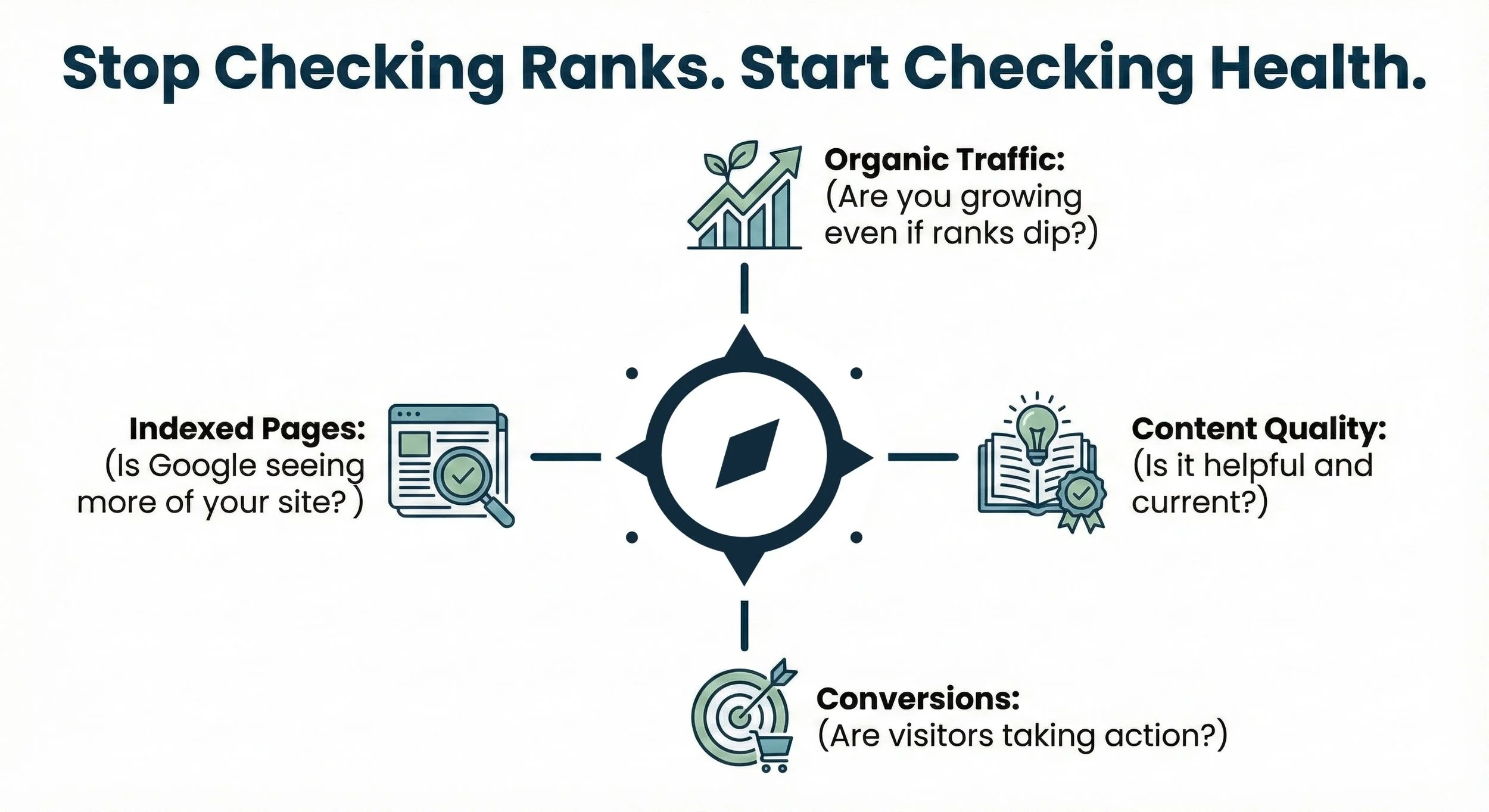
Instead of daily rank checking, focus on:
1. 3-month trends (at minimum)
This gives enough time to smooth out volatility and see true direction.
2. Overall organic traffic
Even if keywords dip in position, your traffic may still be growing.
3. Conversions from organic search
Rankings are a vanity metric if they don’t lead to action.
4. Indexed pages over time
Are more pages showing up in Google’s index? Good sign.
5. Content quality and relevance
Is your content actually helpful? Current? Aligned with search intent?
6. Your competitors’ movements
If everyone is fluctuating: it’s the algorithm, not your site.
When Should You Worry About SEO Drops?
Only when you see sharp declines across 4+ weeks, such as:
Sustained traffic drops
Multiple high-performing keywords fall and don’t recover
New content isn’t indexing after 1–2 months
Entire sections of your site disappear from search
This suggests website changes, technical issues, or an algorithm update that affects your niche.
The Sustainable Marketing Approach: Slow, Steady, Strategic
Here’s where (what I like to call) the “Boondock Strategy” mentality matters.
Just like navigating the literal boondocks, you won’t get far by constantly changing direction every time a tree branch cracks. You need a compass. A steady guide to help you move forward with purpose, not panic.
SEO works the same way. Sustainable, long-term strategies:
Build resilience
Create compounding growth
Reduce wasted time and resources
Keep you grounded through volatility
You don’t need frantic sprints. You need the right direction, and enough time to walk the path.
Summing Up in One Deep Breath…
SEO isn’t broken. Google isn’t out to get you. (although sometimes that’s up for debate)
The ecosystem is simply shifting faster than before, and shifts create noise.
Check your SEO monthly, evaluate quarterly and make strategic decisions then. If you’re unsure, keep checking and evaluating until the data consistently shows you an opportunity or strength.
You’ll sleep better.
Your website will perform better.
And your marketing strategy will be far more sustainable.